
History of Internet Infrastructure: From ARPANET Cables to Global Cloud in 2026
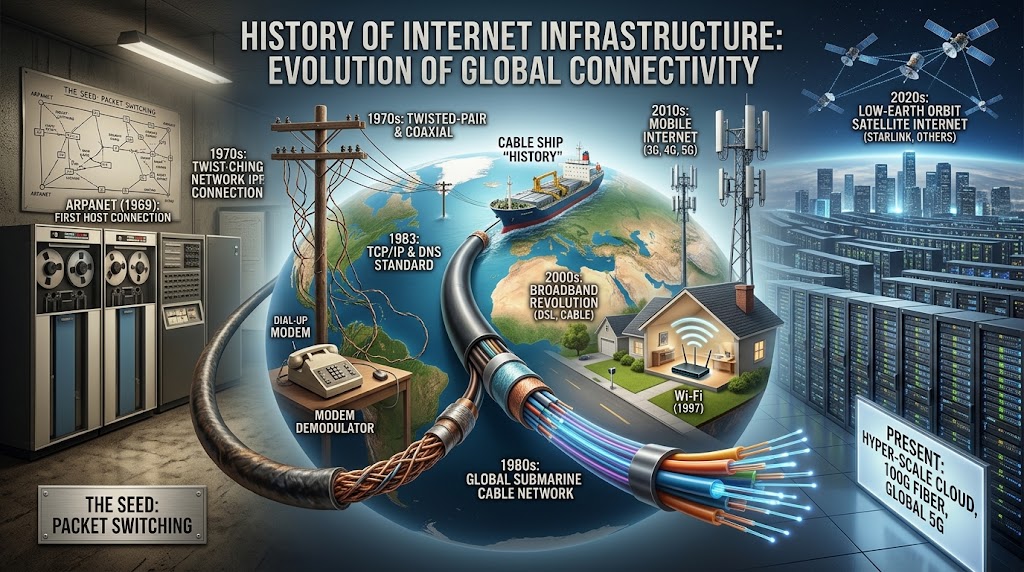
1. Introduction:The History of Internet Infrastructure Started With a Cold War Problem
The history of internet infrastructure starts in 1969 with fear.
The US Department of Defense was scared. What if the Soviet Union bombed their computers? All communication would die.
So ARPA, the Advanced Research Projects Agency, asked a crazy question. Can we build a network that survives a nuclear attack?
That question built the internet.
The history of internet infrastructure is not about websites or apps. It’s about cables under the ocean. Servers in giant buildings. Satellites in space. The physical stuff that makes your Instagram load.
Today in 2026, the internet runs on 550,000 miles of undersea cables, 20 million servers, and billions of devices.
But in 1969 it was 4 computers connected with phone lines.
Why This Story Matters
Because every click you make travels through this infrastructure. And the history of internet infrastructure is how we went from 4 computers to 5.4 billion people online.
2. 1969 to 1972: ARPANET and The First 4 Nodes
September 2, 1969. UCLA. The first ARPANET node went live.
The team tried to log into Stanford. They typed L-O-G. The system crashed after “L-O”.
That was the first message on the internet. “LO”.
By 1970 there were 4 nodes. UCLA, Stanford, UCSB, and University of Utah.
The infrastructure was simple. Phone lines leased from AT&T. Computers called IMPs – Interface Message Processors.
The history of internet infrastructure in these years is about proving the idea worked. Packet switching. If one line died, data found another way.
4 Computers, One Dream
That’s all it took to start.
3. 1973 to 1982: Email, TCP/IP and The History of Internet Infrastructure Grows
In 1973 ARPANET went international. Links to UK and Norway.
Then in 1974, Vint Cerf and Bob Kahn wrote the TCP/IP protocol. This became the language of the internet.
But the real killer app came in 1972. Email. 75% of ARPANET traffic was email by 1973.
The infrastructure had to grow. More routers. More phone lines.
In 1983 ARPANET split into ARPANET and MILNET. Civilian and military.
The history of internet infrastructure here is about standards. TCP/IP became the standard on January 1, 1983. That day is called “flag day”.
TCP/IP Changed Everything
Without it, no internet.
4. 1983 to 1990: DNS, Fiber and The Internet Gets Serious
The history of internet infrastructure hit a wall in 1983. The HOSTS.TXT file was too big.
So Paul Mockapetris invented DNS. Now we could use names instead of numbers.
At the same time, fiber optic cables started replacing copper. 10 times faster.
NSFNet launched in 1986. A high speed backbone for universities. 56kbps, then 1.5Mbps, then 45Mbps.
By 1990, ARPANET was shut down. Its job was done.
From Research to Backbone
The internet was growing up.
5. 1991 to 1995: The Web and The History of Internet Infrastructure Explodes
1991. Tim Berners-Lee invented the World Wide Web.
Nobody knew how big it would get.
In 1993 there were 600 websites. In 1995 there were 23,000.
The infrastructure was not ready. Phone lines jammed. Servers crashed.
So companies built the first data centers. The first ISPs. The first undersea cables for the public.
In 1995 NSFNet was retired. The internet went commercial.
The history of internet infrastructure in these 4 years is about going from 50,000 users to 16 million users.
The Web Broke the Internet
And forced us to build more.
6. 1996 to 2000: The Dot Com Boom and Fiber Everywhere
Investors threw money at anything with “.com”.
Telecom companies laid fiber everywhere. They thought the internet would need infinite bandwidth.
Level 3, Global Crossing, and others laid undersea cables. So much fiber that by 2001 there was 90% unused capacity.
This was called the “fiber glut”.
The history of internet infrastructure during the dot com boom is about overbuilding. But that overbuilding saved us. Because when YouTube and Netflix came, the capacity was there.
Build It and They Will Come
Turns out they were right, just 5 years early.
7. 2001 to 2008: Broadband, Mobile and The History of Internet Infrastructure Goes Home
After the dot com crash, things got real.
Broadband came to homes. DSL and Cable. No more dial-up.
In 2007 the iPhone launched. Mobile internet became real.
Google built its own data centers. So did Amazon and Facebook.
Content Delivery Networks like Akamai exploded. The idea was simple. Put copies of websites close to users.
The history of internet infrastructure here is about moving closer to people. Less distance, faster speed.
The Internet Moved Into Your House
And into your pocket.
8. 2009 to 2015: Cloud, 4G and The History of Internet Infrastructure Goes Global
This is when “the cloud” became real.
Amazon AWS launched in 2006. By 2010 it was huge.
Instead of companies buying servers, they rented them from Amazon, Google, and Microsoft.
At the same time, 4G LTE rolled out. Mobile speeds jumped to 100Mbps.
Undersea cables doubled. In 2010 we had 200,000 miles. By 2015 we had 400,000 miles.
The history of internet infrastructure in this period is about centralization. A few companies now own most of the cloud.
The Cloud Ate Everything
Your photos, your email, your business all live in someone else’s data center now.
9. The History of Internet Infrastructure: 2016 to 2020 5G and Edge
5G started rolling out in 2019. 10 times faster than 4G.
But speed wasn’t the only goal. 5G was built for “edge computing”. Put small data centers everywhere.
The idea: your car, your fridge, your game needs data with 1ms delay. So put servers in every city.
At the same time, companies like Cloudflare built “edge networks”. 300 data centers around the world.
The history of internet infrastructure here is about decentralization again. After 10 years of cloud centralization, we moved back to the edge.
Closer to You Than Ever
The server is now in your city.
10. 2021 to 2026: The History of Internet Infrastructure Today
Today in 2026 the internet runs on this:
Cables: 550,000 miles of undersea fiber. 95% of all internet traffic goes through them.
Data Centers: 20 million servers. Google alone has 21 data centers.
CDNs: Cloudflare, Akamai, Fastly deliver 80% of web traffic.
Satellites: Starlink has 6,000 satellites. Internet from space.
AI: Data centers now use 2% of world electricity because of AI.
The history of internet infrastructure today is about scale. And power. And AI.
5.4 Billion People Online
All running on this invisible machine.
11. The People Who Built The History of Internet Infrastructure
Vint Cerf and Bob Kahn. TCP/IP.
Paul Mockapetris. DNS.
Tim Berners-Lee. The Web.
The engineers at Cisco, Juniper, and Huawei who built routers.
The crews who lay undersea cables.
Thousands of Names
But most people never heard of them.
12. How Internet Infrastructure Actually Works Today
You type google.com.
1. Your phone asks the nearest cell tower.
2. The tower sends it through fiber to your ISP.
3. Your ISP asks DNS.
4. DNS gives Google’s IP.
5. Your request goes through 15 routers across undersea cables.
6. It hits a Google data center.
7. Google sends the page back through a CDN.
All in 200 milliseconds.
The history of internet infrastructure is making that faster every year.
It Feels Instant
Because 50 years of work made it that way.
13. Cables, Satellites and Wireless: The 3 Layers
The internet has 3 physical layers.
Undersea Cables: 95% of traffic. Owned by Google, Meta, Microsoft.
Satellites: Starlink, OneWeb. For rural areas.
Wireless: 5G towers. WiFi in your house.
The Evoletion of internet infrastructure is the story of balancing these 3.
Redundancy Saves the Internet
If one cable cuts, traffic reroutes.
14. Problems in The History of Internet Infrastructure
It’s not perfect.
Centralization: 3 companies own most of the cloud.
Power: Data centers use too much electricity.
Security: DDoS attacks can take down whole countries.
Access: 2.6 billion people still have no internet.
Engineers are working on all of this.
Every Solution Creates New Problems
But we keep building.
15. The Future of The History of Internet Infrastructure
What’s next?
6G: 100 times faster than 5G.
Quantum internet: Unhackable communication.
AI data centers: Special chips for AI.
Space internet: 50,000 satellites.
The history of internet infrastructure is still being written.
2030 Prediction
Internet will feel invisible. Like electricity.
16. Final Thought: The History of Internet Infrastructure Is The History of Us
The history of internet infrastructure started with 4 computers and fear of nuclear war.
Today it connects 5.4 billion people.
It’s cables on the ocean floor. Servers in deserts. Satellites in space. Code written by people you’ll never meet.
Every time you watch a video, send a message, or ask AI a question, you’re using this invisible machine.
And it keeps growing.
The history of internet infrastructure proves one thing. When we build together, we can connect the world.
Frequently Asked Questions
1. When did internet infrastructure start
The history of internet infrastructure starts in 1969 with ARPANET and 4 connected computers.
2. Who invented the internet
No single person. Vint Cerf and Bob Kahn invented TCP/IP. Tim Berners-Lee invented the Web. Thousands built the infrastructure.
3. How many undersea cables are there
Over 550 cables covering 550,000 miles in 2026.
4. What is the cloud
The cloud is just someone else’s data center. Amazon, Google, and Microsoft own most of it.
5. How fast is internet infrastructure today
5G is 10Gbps. Fiber is 400Gbps. Average global speed is 80Mbps.
6. What is edge computing
Putting small data centers close to users to reduce delay. Key for gaming and AI.
7. How much power do data centers use
About 2% of world electricity in 2026. Growing because of AI.
8. What is next for internet infrastructure
6G, quantum internet, and 50,000 satellites for global coverage.