History of E-commerce: Complete Timeline From 1969 to 2026
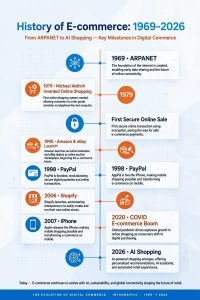
History of E-commerce: How It All Started in 1969
The history of E-commerce did not start with Amazon. Everyone thinks it started with Jeff Bezos in a garage. But the real history of E-commerce started 10 years before the internet existed for normal people.
It started with war.
1969, US Department of Defense was scared. They needed a network that could survive nuclear attack. So they created ARPANET. On October 29, 1969, at UCLA, a student named Charley Kline tried to send the word LOGIN to a computer at Stanford. The system crashed after LO. But the message went.
That LO is the first moment in the history of E-commerce. Because that network became the internet. And the internet became the mall.
By 1971 ARPANET had 23 computers. Email was invented. By 1973, 30 universities.
But shopping? No one thought about shopping yet.
Then came Michael Aldrich. If anyone is the father of E-commerce, it is him. In 1979 in England, he connected a TV to a telephone line and a computer. He called it videotex. He wanted people to shop from home.
In 1984, Jane Snowball, a 72 year old woman in Gateshead, England, with a broken leg, ordered groceries from Tesco via her TV. Margarine, eggs, cornflakes. First online home shopper in history of E-commerce.
Nobody remembers her. But she is first.
In 1980s, E-commerce was called EDI. Electronic Data Interchange. Walmart in 1983 forced all suppliers to use EDI. No more paper invoices. Send orders by computer. Ford, General Motors did same.
1982: Boston Computer Exchange. First online marketplace for used computers. Made by MIT guys.
1984: CompuServe Electronic Mall. First online mall with 100 stores. You needed dial up modem that made weird noise.
The history of E-commerce in 1980s was boring infrastructure. But without it, Amazon could not exist.
History of E-commerce on Wikipedia
History of E-commerce in the 1990s: Amazon and eBay Birth
1990: Tim Berners-Lee invents World Wide Web at CERN. HTML, URL, HTTP. Now anyone can make website.
1991: Web is free.
1992: Charles Stack launches Book Stacks Unlimited in Cleveland. First online bookstore with 400,000 books. Jeff Bezos later copies idea.
1994: Most important year in history of E-commerce.
January 1994: Pizza Hut in Santa Cruz launches PizzaNet. First online pizza order.
August 11, 1994: Dan Kohn’s NetMarket. Phil Brandenberger in Philadelphia buys Sting CD Ten Summoners Tales for 12.48 dollars plus shipping. First secure encrypted online transaction. Uses PGP encryption.
Same year, Netscape Navigator launches. First browser for normal people with pictures.
And Jeff Bezos quits hedge fund job. He drives from New York to Seattle. Writes business plan on paper while his wife MacKenzie drives.
1995: History of E-commerce explodes.
July 16, 1995: Amazon.com goes live from garage in Bellevue, Washington. First book sold: Fluid Concepts and Creative Analogies by Douglas Hofstadter. Bezos packs it himself.
He chooses books because there are 3 million books in print. Biggest Barnes and Noble only holds 175,000. Online you can sell all.
He names it Amazon after biggest river. Biggest bookstore.
September 3, 1995: Pierre Omidyar starts AuctionWeb in San Jose. Part of his personal site. First item sold: broken laser pointer for 14.83 dollars. Buyer says I collect broken laser pointers.
That becomes eBay.
1998: PayPal founded as Confinity by Max Levchin, Peter Thiel, Luke Nosek. Merge with Elon Musk X.com. They give 10 dollars free for signing up. Growth crazy.
1999: Dot com bubble. Everyone wants to be Amazon. Pets.com spends 1.2 million on Super Bowl ad with sock puppet. Loses money on every sale. Sells dog food cheaper than buying it.
Webvan: Grocery delivery. Builds huge warehouses. Burns 1.2 billion dollars. Fails because people like to pick their own apples.
Boo.com: European fashion. Burns 135 million in 18 months.
Nasdaq up 400 percent. Then crashes.
E-commerce 2000 to 2006: Bust, Survival, and Shopify
March 10, 2000: Nasdaq peaks at 5,048. Then falls 78 percent by 2002.
52 percent of dot coms die. Pets.com, Webvan, Boo.com die.
But Amazon survives. Stock goes from 106 to 6 dollars. People say Amazon will die. Bezos keeps cutting costs.
eBay survives because no inventory. It is marketplace.
2002: eBay buys PayPal for 1.5 billion. Now history of E-commerce gets easy payments.
2003: Jack Ma launches Taobao in China to fight eBay. Taobao free for sellers. eBay charges. Taobao wins China. Becomes Alibaba.
2003: Amazon starts idea of AWS. They built huge servers for Christmas rush that sit empty in summer. Why not rent? AWS becomes biggest profit.
2004: Tobias Lutke in Ottawa, Canada loves snowboards. Wants to sell snowboards online. Tries Yahoo Stores, Miva. They are terrible. So he builds own store with Ruby on Rails. Calls it Snowdevil. Then realizes store software better than snowboards. So he starts Shopify in 2006.
Goal: Make opening online store as easy as opening blog.
2007: Magento launches in Los Angeles. Open source. Free. By 2010, 30 percent of all online stores use Magento.
2008: BigCommerce launches in Sydney.
Now anyone can sell. This is huge moment in history of E-commerce. Now 4.6 million stores use Shopify in 2026.
History of E-commerce 2007 to 2015: iPhone and Mobile Shopping Revolution
January 9, 2007: Steve Jobs holds iPhone. Says today Apple reinvents phone. He also reinvents shopping.
Before iPhone, E-commerce on computer at desk.
After iPhone, store in pocket.
2008: App Store launches. Now shopping apps.
2009: Mobile E-commerce only 1 percent of total.
By 2016: 50 percent. By 2026: 73 percent.
One thumb buying. That is history of E-commerce after iPhone.
2010: Instagram launches. First just filters. Then girls post dresses. Where did you buy? Link in bio becomes business model.
2011: Stripe launches. Two Irish brothers Patrick and John Collison, 19 and 21 years old. They hate how hard it is to take payments. PayPal needs weeks. They make Stripe: 7 lines of code to accept card. Now any developer can build store.
2012: Amazon buys Kiva Systems for 775 million dollars. Kiva makes orange robots that move shelves. Now Amazon can ship in 2 hours.
2013: Same day delivery starts in big cities.
2014: Amazon Prime has 50 million members paying 99 dollars a year for free shipping. People now check Amazon first.
2014: Alibaba IPO: 25 billion dollars. Biggest IPO ever at that time. Jack Ma richest man in China.
2015: Amazon accounts for 51 percent of all US E-commerce growth. If market grows 10 billion, Amazon gets 5.1 billion.
History of E-commerce 2010 to 2015 is Amazon becoming like electricity. Infrastructure.
History of E-commerce 2016 to 2019: Social and Invisible Checkout
2016: Instagram adds shoppable tags. Tap dress, buy.
2017: Amazon buys Whole Foods for 13.7 billion dollars. Why? Grocery last big category not online.
2018: Shopify hits 1 billion dollars revenue. 1 million merchants.
2019: Instagram Checkout launches. Buy without leaving Instagram.
Subscription booms: Dollar Shave Club, BarkBox, HelloFresh. Pay monthly, box comes.
AI recommendation: Amazon says 35 percent of sales from recommendation engine. You looked at shoes, here are socks.
Voice commerce: Alexa, reorder paper towels. 22 million people buy via voice in 2019.
History of E-commerce 2016 to 2019 is making checkout invisible.
History of E-commerce 2020: COVID Made Online Shopping 10 Years Faster
March 2020: WHO declares pandemic. Shops close.
E-commerce growth that would take 10 years happens in 3 months.
US E-commerce grows 32.4 percent in 2020. Normal was 14 percent.
Amazon hires 400,000 workers in 100 days. Hires entire city.
Shopify stock goes from 300 to 1,400 dollars in one year. Every small shop that closed physical store opened Shopify store.
Grocery E-commerce: 2019 only 3.4 percent of groceries online. June 2020: 12 percent. People who never bought groceries online tried and never went back.
Buy Online Pick Up In Store and Curbside becomes normal. Walmart, Target, Home Depot all offer.
History of E-commerce will remember 2020 as biggest jump ever.
History of E-commerce 2021 to 2023: Live Commerce and BNPL
2021: Buy Now Pay Later explodes. Afterpay, Klarna, Affirm. Buy 200 dollar shoes, pay 50 now, 50 every two weeks. No interest. Gen Z loves. 43 percent US shoppers used BNPL.
2022: TikTok Shop launches in US and UK. Huge in history of E-commerce.
In China live commerce already 400 billion dollars. People watch person live selling lipstick and buy instantly. Now TikTok brings to US. Girl in LA goes live, tries 10 dresses, 20,000 watch, 3,000 buy in one hour.
2023: ChatGPT plugins. You can say to ChatGPT: Find me best noise cancelling headphones under 200 dollars with good reviews for flying. ChatGPT searches Amazon, Best Buy, finds top 5.
AI agent shopping begins.
E-commerce in 2026: AI Shopping and Future
We are now in 2026. History of E-commerce current chapter.
Three big trends in 2026.
1. AI Agent Commerce: You dont shop. Your AI shops. You say: Hey Meta AI, moms birthday next week, she likes gardening, 65, gift under 80 dollars. AI searches 10 stores, reads 500 reviews, buys best, arranges delivery. You do nothing. Shopify says 18 percent of purchases in 2026 started by AI agents, not humans.
2. AR Try On: Try before you buy with phone. Ray-Ban Meta glasses: Look at sofa, see how it looks in living room. Try on glasses with face filter. Try on shoes with feet. This cuts returns by 25 percent. Returns biggest problem.
3. One Click Everywhere: In 2026 you never type credit card. Shop Pay, Apple Pay, Google Pay, PayPal One Touch. 78 percent of checkouts use one click wallet.
4. Sustainability and Resale: ThredUp, RealReal, Patagonia Worn Wear. People buy used clothes more than new in Gen Z. Resale grew 48 percent in 2025.
5. Cross Border: Temu and Shein ship 3 million packages a day from China to US and Europe. Make cross border normal.
Numbers in 2026:
Global E-commerce sales: 8.1 trillion dollars. Up from 1.3 trillion in 2014.
24 percent of all retail sales online. In China 46 percent.
Mobile 73 percent.
Shopify powers 4.6 million stores.
Amazon has 310 million Prime members.
History of E-commerce 2024 to 2026 is AI doing shopping.
How E-commerce Works Behind One Click in 2026:
Step 1 Discovery: TikTok, Instagram, Google, AI chat.
Step 2 Store Front: Shopify, WooCommerce, BigCommerce, Magento.
Step 3 Payment: Stripe, PayPal, Shopify Payments take 2.9 percent plus 30 cents. Check fraud with AI in 0.2 seconds.
Step 4 Warehouse: Robot picks item. Kiva robots move shelves.
Step 5 Shipping: UPS, FedEx, DHL, USPS. Real time tracking. 65 percent US orders delivered in 2 days or less.
Step 6 Returns: 30 percent clothing returned. Companies like Happy Returns have bar in mall, drop box no label.
This chain built over 57 years of history of E-commerce.
Biggest Lessons From History of E-commerce:
Lesson 1: Too Early is Same as Wrong. Michael Aldrich invented online shopping 1979 but internet not ready. Failed. Timing matters.
Lesson 2: Infrastructure Wins, Hype Dies. Pets.com had great ads but lost money on every order. Amazon built warehouses and robots and won.
Lesson 3: Make it Easy for Seller, Not Just Buyer. Shopify won because easy to sell. Stripe won because easy to take payments.
Lesson 4: Mobile First. Every E-commerce company that did not go mobile by 2015 died.
Lesson 5: Trust is Everything. PayPal, reviews, free returns, Prime shipping. All about trust.
What is Next After History of E-commerce:
2028: No websites. You talk to AI in Meta AI, ChatGPT. AI buys for you.
2030: Drone delivery. Amazon Prime Air already testing in Texas. 30 minute delivery for items under 5 pounds.
2032: Stores become showrooms. You go to Nike store to try shoe, scan foot, then order online custom color delivered in 2 hours.
2035: AI knows you need margarine before you know.
History of E-commerce started with 72 year old woman ordering margarine on TV because she could not walk to store. Next is AI ordering margarine before you know you ran out.
It started with idea that shopping should come to you. In 2026 it does.
FAQ:
1. When did history of E-commerce start?
1969 ARPANET, but first real online shopping system 1979 by Michael Aldrich.
2. Who invented E-commerce?
Michael Aldrich in 1979.
3. When was Amazon founded?
July 5, 1994 by Jeff Bezos, live 1995.
4. When was eBay founded?
September 3, 1995 as AuctionWeb by Pierre Omidyar.
5. What was first thing sold online?
Sting CD for 12.48 dollars on August 11, 1994 first secure transaction, and Pizza Hut pizza.
6. How big is E-commerce in 2026?
8.1 trillion dollars globally, 24 percent of all retail.
7. What is biggest E-commerce company?
Amazon in US and Europe, Alibaba in China.
8. What is future of E-commerce?
AI agent shopping, AR try on, live commerce, drone delivery.